

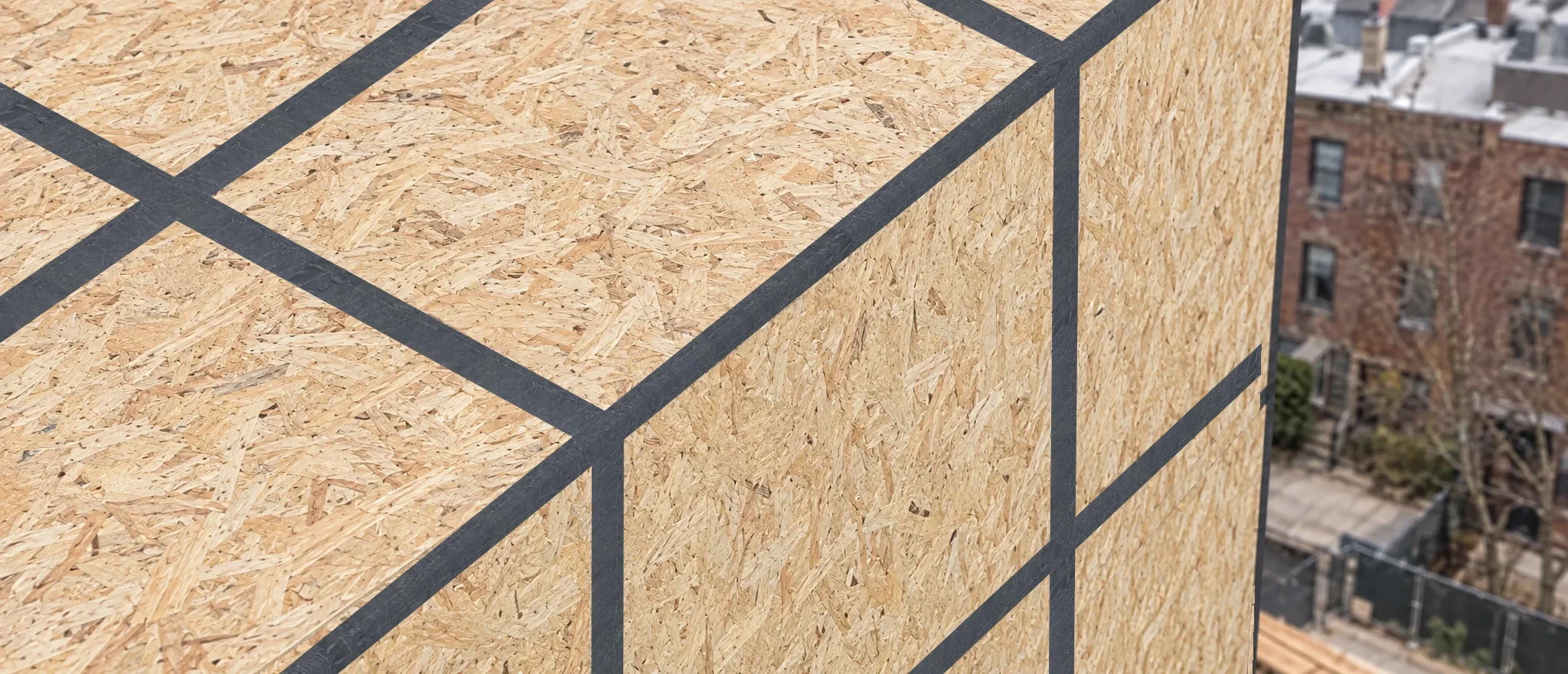
Monopoly framing is a construction approach in which exterior wall sheathing meets roof sheathing without conventional projecting rafter tails. Its compact silhouette resembles a Monopoly game house. The practical benefit is a more straightforward roof-to-wall connection for air sealing and enclosure detailing.
For residential builders, the appeal goes beyond appearance: simpler connections can make critical details easier to install, inspect, and repeat.
Why Roof-to-Wall Connections Deserve More Attention
A home’s enclosure must manage water, air, vapor, and heat. These functions depend on connections as much as individual materials. A well-designed wall cannot deliver its intended performance if its control layers stop short of the roof.
The broader building-science principle is continuity: connect each control layer to its counterpart in the adjoining assembly.
Small Gaps Can Undermine a Well-Insulated Home
Insulation slows heat transfer; air sealing limits uncontrolled air movement. Installing insulation does not automatically eliminate leakage at framing connections or openings.
That distinction matters when reviewing details before construction. Builders need to identify both the insulation boundary and the air barrier, then make their connections buildable.
How Monopoly Framing Simplifies the Enclosure
Conventional roof overhangs can introduce framing interruptions at the roof-to-wall boundary. Monopoly framing brings the sheathing surfaces together more directly, reducing the complexity of that junction.
Builders still need to seal the connection and address every penetration. The geometry makes the work more accessible; workmanship determines the result.
Concept illustration.
Connect Each Layer Before Covering It
The design should show how the wall’s water, air, vapor, and thermal controls continue into the roof assembly. Connected wall and roof sheathing can support this strategy, with insulation and other materials arranged around that junction.
A preconstruction review should establish:
-
Where each control layer runs.
-
How the roof-to-wall transition will be sealed.
-
Which materials are compatible.
-
Who installs and checks the connection.
-
When inspection occurs before finishes conceal it.
What Makes Monopoly Framing Different?
Monopoly framing describes the framing configuration. The related “Perfect Wall” concept addresses the arrangement and continuity of enclosure control layers.
A compact roofline alone does not establish a high-performance assembly. The insulation, membranes, openings, and connections must work together throughout the building.

Concept illustration.
Tradeoffs to Resolve Before Choosing Monopoly Framing
Rain Protection Still Requires a Complete Strategy
Water-management details remain essential with or without overhangs. Roof runoff, openings, flashing, and wall drainage must be considered together. Rain-control guidance emphasizes resisting water entry and providing appropriate drainage rather than relying on one exterior feature.
Roof Ventilation Must Be Designed Deliberately
Removing conventional eaves changes the available roof-edge details. A vented roof needs an intentional ventilation path; an unvented assembly requires an appropriate moisture-control design. These decisions should be resolved with the roof structure and insulation strategy.
Exterior Insulation Changes the Connections
Continuous exterior insulation can carry thermal protection across structural elements. Its thickness and placement need coordination with roofing, cladding, and openings. The control-layer strategy should guide those details.
Verify Airtightness Before Construction Moves On
Visual checks confirm installation details, while blower-door testing measures enclosure leakage. Testing can provide feedback and a performance record; its timing should allow practical corrections.
Frequently Asked Questions About Monopoly Framing
Does Monopoly Framing Require Exterior Insulation?
The framing shape and insulation strategy are separate decisions. Continuous exterior insulation supports the related Perfect Wall approach, but the complete assembly must be designed for the project.
Can Monopoly Framing Include Overhangs?
Some designs adapt the concept with limited overhangs. Those adaptations require careful transition detailing.
Does Monopoly Framing Guarantee Better Energy Performance?
No. Insulation, air sealing, and execution remain essential.
For builders, monopoly framing offers a way to simplify one important connection. Its value depends on coordinated design, careful installation, and verification.